When Barbara Bates-Jensen arrived in Haiti after the devastating 2010 earthquake, she expected to treat injuries caused by collapsed buildings and debris. What she didn’t expect were the countless patients suffering from pressure injuries, also called bedsores, so severe that they were life-threatening.
“I saw people dying from something that should never happen,” said Bates-Jensen, a professor in the UCLA Joe C. Wen School of Nursing.
That experience changed the trajectory of her career.
Bedsores affect millions of patients each year, costing billions and claiming tens of thousands of lives. Yet they are almost entirely preventable. The problem? Traditional detection relies primarily on visual cues, such as skin discoloration, that often fail patients with dark skin tones.
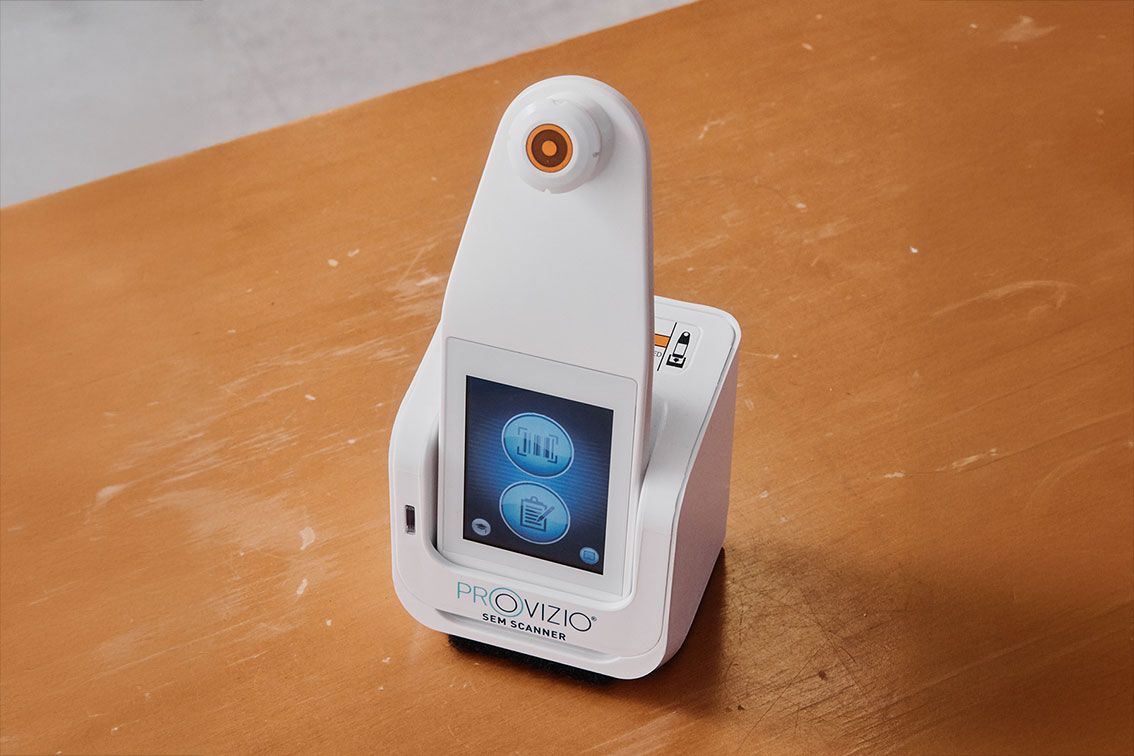
Back at UCLA, Bates-Jensen teamed up with UCLA Samueli School of Engineering professors William Kaiser and Majid Sarrafzadeh to imagine a better way. Their solution was bold: a handheld wireless device that could “see” what the eye cannot. The result was the SEM Scanner, which measures subepidermal moisture, an early sign of tissue damage, days before a sore appears.
“The best part is the device doesn’t care what color the skin is,” Bates-Jensen said. “It’s reading within the tissues.”
The impact has been extraordinary. Licensed to Bruin Biometrics through UCLA’s Technology Development Group, the SEM Scanner has been hailed as one of Time magazine’s best inventions of 2020 and helped Bruin Biometrics earn a spot among Fast Company’s most innovative medical device companies. Today, hospitals across Europe, Canada, and the U.S. use the SEM Scanner to prevent injuries before they start, sparing patients pain and saving health systems millions.
For Bates-Jensen, now associate dean of academic affairs at the UCLA Joe C. Wen School of Nursing, the work isn’t finished. She’s leading clinical research studies to bring the technology to nursing homes, where residents are most at risk. Her mission remains clear: to ensure that no patient suffers because of the color of their skin.
From a disaster zone in Haiti to a global stage, Bates-Jensen’s journey is a testament to UCLA’s spirit of innovation, where engineering and compassion converge to solve problems that matter.
“We didn’t just invent a device,” she said. “We changed the way the world thinks about wound care.”
UCLA nursing professor invents revolutionary device to prevent bedsores
Pressure injuries are all too common in hospitals, an early indicator of serious issues. UCLA School of Nursing's Barbra Bates-Jensen helped create a fast, reliable device that can detect them in time to head off danger - and landed on Time magazine's list of best inventions.